
Learning to Love Ourselves Through Compassion for Others: On parenting, shame, unconditional self-worth, and the difficult practice of compassion
· By Joshua D Mckelvey
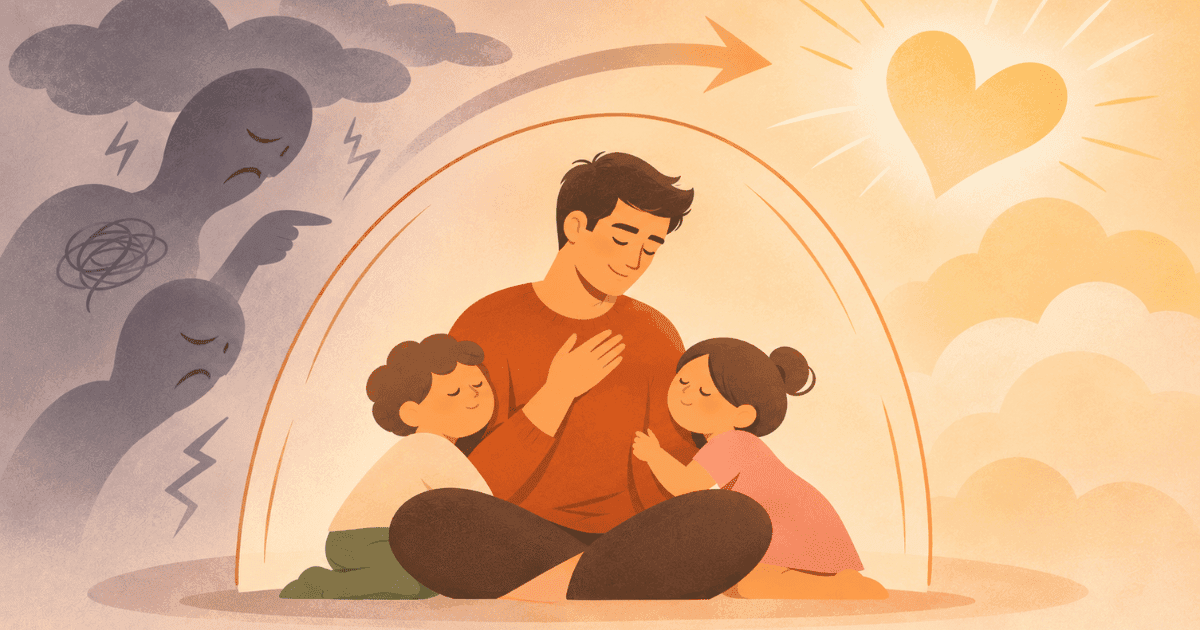
Through my struggles with parenting, shame, and self-worth, I've come to understand compassion in an unexpected way. My children taught me that love doesn't have to be earned, while my parents taught me that our failures don't diminish our humanity. By extending compassion to others, even those whose actions I strongly oppose, I've begun learning to offer myself that same unconditional acceptance. Drawing on psychology and Buddhist philosophy, I explore how compassion can coexist with firm boundaries, accountability, and moral judgment. We can recognize our mistakes, take responsibility, and work toward becoming better people without allowing our failures to define our worth.
I struggle when my partner criticizes my parenting. Not because I think I'm a perfect father, or because I believe her concerns are necessarily misplaced. Quite the opposite. I know I have things to work on. Sometimes I can be stern with our children, and my partner is especially sensitive to moments when my tone feels harsh or intimidating. What registers to me as an ordinary parenting interaction can register very differently to her.
Our thresholds for what constitutes harshness aren't always the same. That doesn't mean she's wrong, and it doesn't mean I'm right. I am actively trying to become gentler. I meditate. I go to therapy. I try to listen to her concerns and receive them as the loving feedback I believe they're intended to be. But sometimes it's incredibly difficult.
When I see disappointment or fear in her reaction to something I've done, I experience a powerful mixture of shame, frustration, and embarrassment. I feel like a bull in a china shop, as though my ordinary way of moving through the world is somehow dangerous or unacceptable. And almost immediately, a disagreement about a specific parenting behavior becomes something much larger. I don't just wonder whether I handled the situation poorly. I wonder whether I'm a bad father.
When Criticism Becomes Shame
I've spent a considerable amount of time in therapy exploring my relationship with self-worth. Some of that work has involved EMDR and processing childhood experiences with bullying and my relationship with my mother. My mother is a wonderful person, but she has also struggled with emotional reactivity and irritability. When I was young, I knew I was loved, but I internalized a sense that I was deeply unlikeable. I understand what she was trying to communicate. She wanted to distinguish her love for me from her frustration with my behavior. But to a child, that distinction can be difficult to make. Love may be unconditional in principle, while acceptance feels conditional in practice. I can't say that those experiences explain every emotional reaction I have today. Human development is considerably more complicated than that. But I can recognize how easily another person's disappointment can become evidence, in my own mind, that something is fundamentally wrong with me.
Psychological research offers some useful context. Self-compassion interventions have shown promise for reducing self-criticism and emotional distress. In a randomized trial, Krieger et al. (2019) found that a compassion-focused intervention helped adults struggling with elevated self-criticism improve their emotional well-being. That research doesn't explain my personal history, but it supports a distinction I've been learning to make: evaluating our behavior and condemning ourselves are not the same psychological process. It's possible to recognize a mistake without turning it into a judgment about our fundamental worth. I understand that intellectually. Emotionally, it's been much harder.
What My Children Taught Me About My Own Worth
I've come to believe that tying our worth to professional accomplishments, financial success, social approval, or even our ability to experience pleasure is a precarious way to live. All of those things can change. Careers falter. Money disappears. Relationships become strained. Our abilities decline. Even happiness is temporary. If our worth depends on constantly satisfying some external standard, we are forever at risk of losing it. I believe our fundamental human worth should be intrinsic, not earned. But I didn't arrive at that belief through an abstract philosophical argument. My children taught it to me.
I love my children unconditionally. They don't have to accomplish anything to earn that love. They don't have to perform well in school, demonstrate exceptional talent, become successful adults, or even behave particularly well. Their failures don't diminish their worth to me. I can and do become frustrated with their behavior. I can establish boundaries and insist that they make amends when they've hurt someone. But underneath those everyday challenges, my love for them remains. They are worthy of love simply because they exist. And somewhere along the way, I realized that I am little more than a wrinkled, gray-haired, forty-year-old child. Why should I have to earn something that I recognize so effortlessly in them?
The psychological concept of unconditional self-acceptance is particularly relevant here. It involves resisting the tendency to assign ourselves a global value based on individual behaviors, failures, or achievements. In a study comparing self-compassion and unconditional self-acceptance exercises, Crișan et al. (2022) found that participants in both groups reported improved self-acceptance and reduced shame. The study suggests we can acknowledge our shortcomings without treating them as evidence that we are fundamentally inadequate. And yet, despite believing all of this, I remained absolutely brutal with myself when it came to parenting. Until a recent realization in therapy helped something finally begin to shift.
What My Parents Taught Me About Failure
My children taught me that love doesn't have to be earned. My parents taught me that love doesn't have to be forfeited. Neither of my parents was always the parent they wanted to be. They had their own difficulties, emotional struggles, and imperfect relationships with self-worth. Those struggles sometimes influenced how they treated the people around them. As an adult, I can acknowledge their mistakes. I can recognize how certain experiences affected me without pretending that everything was acceptable. But looking back, I realized something remarkably simple. Their failures do not diminish their value to me as human beings. Neither do their successes determine that value.
I love my parents as imperfect people. I can be disappointed in their behavior without being disappointed in their humanity. I can recognize that they sometimes hurt me without reducing them to the people who caused that hurt. And suddenly I saw the contradiction in how I treated myself. If my parents' failures as parents don't diminish their worth, why should my failures as a parent diminish mine? This realization was more than intellectual. I felt something release. Not relaxation, exactly. The difficulties were still there. My childhood experiences hadn't disappeared, and neither had the work I needed to do as a father. But for a moment, it felt as though I no longer had to defend my worth against my imperfections. Then I realized the principle extended far beyond my relationship with my parents.
Turning Compassion Outward to Find It Within
We often think about self-compassion as an inward practice. We encourage ourselves to be kinder, to forgive ourselves, and to recognize our strengths. But I discovered something almost in reverse. I learned how to value myself despite my failures by examining how I value other people despite theirs.
Consider my partner. Sometimes I see her reactions as overly sensitive. Sometimes I might even perceive her behavior as unfair, controlling, or manipulative. But would I ever conclude that those behaviors diminished her fundamental worth as a person? Of course not. I might question how she interprets a situation. I might disagree with her criticism. I might need to establish boundaries or explain how her reactions affect me. But none of that changes her humanity.
The same principle applies to people I don't particularly like, people who have hurt me, and even people whose actions I find morally objectionable. And that's where compassion becomes something much more demanding than simply being nice to people.
Compassion Does Not Require Approval
I strongly object to the current administration's actions and priorities. I believe some of its policies and political strategies warrant serious opposition, particularly where I see threats to the dignity, safety, or rights of vulnerable people. But does that mean I should devalue the humanity of those in office or the people who support them? No. That would contradict the very ethical principle I'm trying to practice. I sometimes wonder whether fear plays an important role in contemporary political movements. Fear of immigrants, fear of cultural change, fear of losing social status, fear of people who don't conform to familiar expectations. But I don't know what motivates every individual who participates in a political movement, and compassion doesn't require me to pretend that I do.
That's actually one of its strengths. Compassion begins with curiosity, not certainty. What might this person be afraid of? What needs might they be trying to fulfill? What experiences or circumstances could help explain their behavior? We don't necessarily need answers. The willingness to ask prevents us from collapsing a complex human being into a single opinion, action, or political identity.
This connects closely with research on wisdom. Grossmann et al. (2020) describe wisdom as including intellectual humility, perspective-taking, sensitivity to context, and recognition of uncertainty. Those capacities matter because we rarely make moral judgments with complete information. Compassion can encourage us to remain curious about another person's humanity, while wisdom reminds us that our interpretations may be incomplete. Neither requires us to abandon our convictions. We can oppose harmful actions without deciding that the people responsible are somehow less human. In fact, compassion becomes most meaningful when it extends beyond the people we naturally love or agree with.
The Buddhist Connection: Compassion and Wisdom
Buddhist philosophy offers another way to understand this insight. A central idea in Buddhist thought is that human beings are interdependent rather than isolated, unchanging entities. Our experiences, identities, and behaviors arise within complex networks of relationships and conditions. Inada (2000), writing about emptiness and Buddhist ethics, argues that an understanding of interdependence can support compassion and active moral responsibility. Importantly, this does not mean that individuals have no responsibility for their actions, or that harmful behavior should simply be accepted as the inevitable product of circumstances. Rather, it challenges the tendency to view people as possessing some fixed, essential moral identity. A person is not reducible to their worst behavior. Neither are they reducible to their best.
This perspective resonates deeply with what I've been learning through parenting and therapy. My mother's irritability was real. Its effects on me were real. But she is more than those moments. My own frustration as a father is real. Its effects on my children matter. But I am more than those moments, too. Buddhist ethics also connects compassion with wisdom. Compassion without discernment can become ineffective or permissive. Wisdom without compassion can become cold and detached. Together, they invite us to understand suffering while still responding appropriately to harm.
Compassion Can Be Firm
Consider an abuser and a victim. It's relatively easy to recognize why the victim deserves compassion. They need protection, safety, support, and recognition of the harm they've experienced. But what would compassion toward the abuser look like? It wouldn't mean excusing the abuse, minimizing its consequences, or demanding forgiveness from the victim. It might involve asking questions about the person responsible. What makes you believe this behavior serves you? Are you trying to establish control because you feel powerless? Have your experiences made it difficult to trust other people?
We shouldn't assume that every abusive person has suffered some particular trauma or that their actions are driven by hidden pain. The questions are an invitation to understanding, not an invented explanation. And ultimately, our response may be very firm:
I cannot allow you to continue hurting yourself or other people. But I can still recognize your humanity and value it.
Compassion for the victim and compassion for the abuser do not necessarily conflict. Their interests and desired outcomes may conflict, and protecting the victim must take priority when safety is at stake. But recognizing the abuser's humanity doesn't undermine that protection. We can insist on accountability without dehumanization. We can impose boundaries without contempt. And we can acknowledge the possibility of change without making anyone's safety dependent on that change occurring. Compassion is not the absence of consequences. It is the refusal to confuse consequences with human worth.
Anger Is an Alarm, Not an Instruction
I've also been reconsidering the role of anger. I think of anger as an alarm system. It alerts us that something important may be happening. Perhaps a boundary has been crossed. Perhaps someone is being mistreated. Perhaps something we value is threatened. But an alarm is not an instruction manual. It tells us to pay attention, not necessarily what to do next. Anger can be useful, even protective. But we need to measure its expression. Feeling threatened doesn't prove we're in danger. Feeling wronged doesn't establish that our interpretation is correct. And the fact that anger arises doesn't mean aggression is justified.
Research on emotional regulation supports separating emotional experience from behavioral response. For example, Halamová et al. (2021) examined a program combining self-compassion with self-protection and found improvements in several measures of compassionate self-relating and self-criticism. This supports the possibility of developing gentleness toward ourselves and protective assertiveness together. Compassion doesn't require us to suppress anger or surrender our boundaries. It asks us to listen to what the emotion is telling us, without letting it dictate our behavior. This applies to interpersonal conflict, politics, and perhaps most importantly for me, parenting.
Becoming the Parent I Want to Be
I return to the experience that began this reflection. My partner sees something in my parenting that concerns her. I feel ashamed, frustrated, and embarrassed. Sometimes I believe her concern is justified. Other times, I believe she's responding to behavior that is perfectly ordinary. But perhaps the question isn't simply which of us is right. Perhaps the better questions are: What actually happened? How did our children experience it? What was I feeling? What was my partner responding to? And what, if anything, needs to change?
Those questions require curiosity, humility, and a willingness to acknowledge uncomfortable truths. They also require compassion for everyone involved, including me. A disagreement about parenting doesn't need to become a referendum on my worth as a father. My partner's distress deserves consideration, but it doesn't automatically establish that my behavior was wrong. My intentions deserve consideration, but they don't establish that my behavior was harmless. And my shame deserves attention, but it isn't evidence that I'm a failure.
Some research even connects unconditional acceptance to parenting outcomes. Gaviţa et al. (2012) studied a cognitive-behavioral parent-training program that incorporated unconditional acceptance of both parents and children. The program was associated with improvements in parenting practices, parental distress, and children's behavioral difficulties compared with a waitlist group. The intervention included several components, so we can't attribute its benefits specifically to unconditional acceptance. Nevertheless, it offers a useful example of how acceptance and behavioral accountability can coexist within parenting.
I don't need to excuse my mistakes to maintain my self-worth. I can apologize to my children. I can listen to my partner. I can learn to recognize when firmness becomes intimidation, or when frustration begins shaping my tone. I can work on becoming a gentler father. But I don't have to hate myself into becoming one. And perhaps the most important thing I can model for my children isn't flawless parenting. It's the ability to acknowledge a mistake, repair harm, and continue treating myself and others with dignity. I want my children to understand that their worth is not contingent on their performance. I should probably demonstrate that principle in how I treat myself.
The Compassion We Already Know How to Give
I've spent years trying to understand how to become a better person. I've studied mindfulness, philosophy, psychology, and human well-being. I've meditated, gone to therapy, and tried to cultivate greater awareness of my own thoughts and emotions. Those efforts have value. But one of the most meaningful lessons I've learned didn't come from mastering a technique or acquiring another piece of knowledge. It came from looking at the people I love.
My children taught me that love doesn't have to be earned. My parents taught me that love doesn't have to be forfeited through failure. My partner continues to challenge me to recognize the difference between my intentions and the effects of my behavior. And even the people whose actions I strongly oppose remind me that compassion is a principle, not a reward we distribute to those who meet our approval.
None of this makes accountability less important. It makes accountability possible without shame becoming the final verdict. I still struggle when my partner criticizes my parenting. I still experience embarrassment and frustration. Moments still come when the old feelings of inadequacy rush back. An insight, even a deeply emotional one, doesn't immediately undo a lifetime of learned responses. But something has changed.
When I look at my own failures now, I'm beginning to recognize the same imperfect humanity I have always seen in others. And perhaps that's the secret of compassion. We don't have to find goodness in everything people do. We don't have to approve of their choices, excuse their mistakes, or deny the harm they cause. We simply have to remember that their worth as human beings is not ours to award or revoke. And if that principle is worth extending to everyone else, then surely it is worth extending to ourselves. I don't have to earn my humanity by being a perfect father. I have to take responsibility for being an imperfect one. Those are two very different things.
References
Crișan, S., Canache, M., Buksa, D., & Nechita, D. (2022). A comparison between self-compassion and unconditional self-acceptance: Interventions on self-blame, empathy, shame-, guilt-proneness, and performance. Journal of Rational-Emotive & Cognitive-Behavior Therapy, 41, 64–80. https://doi.org/10.1007/s10942-022-00451-5
Gaviţa, O. A., David, D., Bujoreanu, S., Tiba, A., & Ionuţiu, D. R. (2012). The efficacy of a short cognitive-behavioral parent program in the treatment of externalizing behavior disorders in Romanian foster care children: Building parental emotion-regulation through unconditional self- and child-acceptance strategies. Children and Youth Services Review, 34, 1290–1297. https://doi.org/10.1016/j.childyouth.2012.03.001
Grossmann, I., Weststrate, N. M., Ardelt, M., Brienza, J. P., Dong, M., Ferrari, M., Fournier, M. A., Hu, C. S., Nusbaum, H. C., & Vervaeke, J. (2020). The science of wisdom in a polarized world: Knowns and unknowns. Psychological Inquiry, 31(2), 103–133. https://doi.org/10.1080/1047840X.2020.1750917
Halamová, J., Kanovský, M., Varšová, K., & Kupeli, N. (2021). Randomised controlled trial of a new short-term online emotion focused training for self-compassion and self-protection in a nonclinical sample. Current Psychology, 40, 333–343. https://doi.org/10.1007/s12144-018-9933-4
Inada, K. K. (2000). The nature of emptiness and Buddhist ethics. Chung-Hwa Buddhist Journal, 13(2), 255–275.
Krieger, T., Reber, F., von Glutz, B., Urech, A., Moser, C. T., Schulz, A., & Berger, T. (2019). An internet-based compassion-focused intervention for increased self-criticism: A randomized controlled trial. Behavior Therapy, 50, 430–445.