
Things We Can Do
· By Joshua D Mckelvey
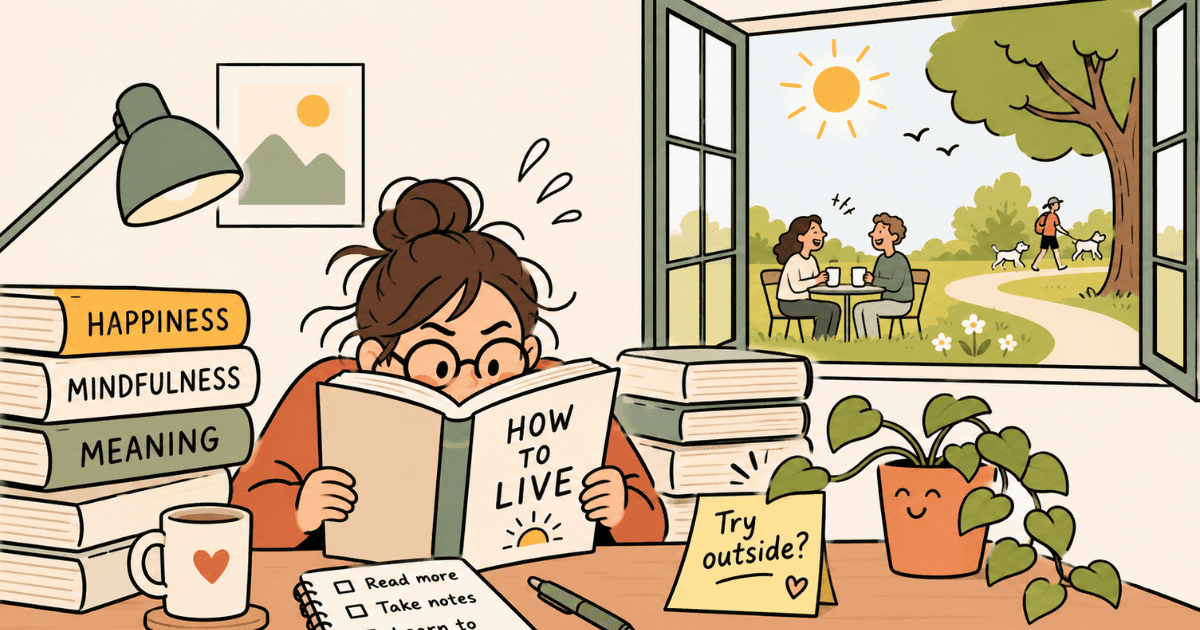
We have more information about happiness and well-being than ever before, but knowing how to live well and actually doing it are two different things. Drawing on science, philosophy, and spirituality, I explore practical ways to improve our well-being through relationships, mindfulness, meaningful activities, and community. This isn't another self-improvement checklist. It explores what actually matters, what we can realistically do, and why living well takes more than individual effort. Sometimes the most important step isn't learning something new. It's putting what we already know into practice.
I love books. There is something almost magical about them when you think about it. Knowledge, imagination, and experience captured in words, preserved across time, and made available to someone who might not even be born for another thousand years. We can sit down with the thoughts of someone who lived centuries ago, wander through worlds that have never existed, or discover something about the universe without leaving our chairs.
Growing up, it was Goosebumps and The Hardy Boys, then Tolkien and Asimov. I loved how an entire world could be built from words. Eventually, my curiosity wandered into mythology, history, science, and philosophy. As I've gotten older, I've moved in and out of psychology, sociology, spirituality, and the seemingly bottomless world of self-help.
I've always been looking for something. On some level, I think I've spent much of my life convinced that if I just read enough books, I might eventually uncover the secrets of the universe. And in many ways, that isn't entirely unreasonable. Books really can reveal extraordinary things about ourselves and the world. But I also have a habit of approaching the next book with the vague suspicion that enlightenment is waiting somewhere around the next page. An old Zen teaching story tells of a visitor whose cup of tea is filled until it overflows. The overflowing cup represents a mind so full of its own ideas that there is little room for anything new. I recognize myself in that story. Not as the wise teacher pouring the tea, unfortunately, but as the cup.
I don't think there is anything wrong with pursuing knowledge. Curiosity, learning, and the pleasure of understanding something new are meaningful parts of my life. But I've also come to recognize that I can become so occupied with trying to understand life that I sometimes lose touch with the experience of living it. I can read about mindfulness without being particularly mindful. I can study the importance of relationships while neglecting to make time for people. I can spend an afternoon reading research about the restorative benefits of nature, only to realize that the sun has gone down. There's a certain absurdity to knowing quite a bit about well-being without always doing the things that support it.
My relationship with spiritual traditions reflects a similar tension. I'm not particularly religious. Faith makes me uncomfortable when it demands certainty or discourages questioning, and I have serious reservations about some of the teachings and practices associated with organized religion. Yet I also find tremendous wisdom in religious and philosophical traditions. Again and again, I encounter reflections on compassion, love, generosity, attention, and our relationships with one another. Aristotle wrote about friendship and flourishing. Buddhist traditions have explored suffering, compassion, and the relationship between our perceptions and our experience. The biblical book of Ecclesiastes emphasizes companionship and mutual assistance (4:9–10), while the Qur'an describes human diversity as an opportunity for people to come to know one another (49:13). These traditions are not interchangeable, and their disagreements are real. Some of their claims deserve skepticism, even outright rejection. But recurring insights are hard to dismiss.
One of them is the idea that the separation we experience between ourselves, other people, and the world around us may not tell the whole story. Some spiritual traditions make a stronger claim, suggesting that our separateness is ultimately an illusion. I don't know how we would establish that metaphysically. But the more modest claim that we are profoundly interconnected is something we can investigate. Biology, psychology, sociology, and ecology provide plenty of reasons to question the image of the completely independent individual. Our lives are shaped by other people, communities, institutions, and environments. Our health, development, opportunities, and even our understanding of ourselves depend upon relationships extending far beyond our immediate awareness. In that sense, I do have something resembling faith in our interconnectedness. Not a faith that needs protection from skepticism, but a conviction that becomes more meaningful when examined critically. None of this means we cannot feel lonely, disconnected, or profoundly separate. We certainly can. Nor does connection guarantee that life will be kind or that things will work out. But it does suggest that living well involves more than what happens inside our own heads.
And this brings me back to a question I've spent a considerable amount of time reading about: What can we actually do to live better? There is no shortage of advice. Exercise, meditate, eat better, sleep more, practice gratitude, find your purpose, develop meaningful relationships, spend time outside. Taken individually, much of it is reasonable. Taken together, it can begin to feel like another full-time job. Apparently, even happiness needs an app and a regimen. But well-being isn't something we earn by following a perfect routine. It isn't the permanent absence of suffering, a continuous feeling of happiness, or proof that we have successfully optimized ourselves. We experience it in the course of living. And much of what philosophy, spirituality, and contemporary research suggest we can do to support it is remarkably ordinary.
Make Time for Other People
If there is one theme that keeps emerging from the research on well-being, it is the importance of relationships. Human beings are social creatures, although the amount and kind of connection we need varies considerably. We depend on relationships for much more than companionship. They shape our development, our sense of belonging, and our ability to navigate difficult circumstances. In a large meta-analysis, Holt-Lunstad et al. (2010) found that stronger social relationships were associated with better survival. More recent research suggests that structured group activities and certain forms of social support can modestly reduce loneliness, particularly among older adults (Shekelle et al., 2024).
But being around people and feeling connected to them are not the same thing. We can have hundreds of online contacts and feel terribly alone. We can also have a relatively small circle of relationships that provides genuine belonging. Aristotle's treatment of friendship offers something useful here. Friendship isn't simply a resource we possess because it makes us healthier or happier. It is part of the shared activity of living well (Sherman, 1987). We shouldn’t become so accustomed to evaluating activities according to their benefits that even our relationships become another instrument of self-improvement. Friendship doesn't need to justify itself by reducing our mortality risk. Sometimes we should spend time with people simply because we enjoy their company, because we care about them, or because sharing life with others is worthwhile in its own right.
So call someone. Invite a neighbor over. Share a meal. Join a group organized around something you enjoy. Make time to spend with people without needing a particular reason. And when you're with someone, try actually being with them. Listen. Pay attention. Be curious about another person's experience. Connection isn't always something we find. Often, we cultivate it.
Move Your Body, and Give It Some Rest
Our bodies are not merely vehicles for carrying our brains from one interesting book to another. As much as I sometimes behave otherwise. Physical activity is one of the more reliable ways to support health and functioning, and it can improve aspects of psychological well-being. For example, Song et al. (2026) found that a community-based dancing program improved physical functioning and several measures of psychological well-being among older adults compared with a health-education group.
I find the dancing example particularly appealing because it illustrates something that gets lost in conversations about exercise. Movement doesn't have to be another achievement. We tend to frame exercise in terms of goals, performance, appearance, and measurable progress. Those things can be useful, but movement can also be enjoyable, social, playful, or simply part of everyday life. Walk somewhere. Dance in your kitchen. Work in a garden. Ride a bicycle. Stretch. Play with your children. Find activities that fit your abilities and that you might actually want to do again. For people living with illness, disability, or chronic pain, physical activity may require adaptation or professional guidance. Physical well-being isn't defined by athletic performance or the absence of limitations.
And movement is only part of the picture. Rest matters too. We live in a culture that often treats rest as a reward for productivity. We earn the right to relax by accomplishing enough, and even relaxation can become something we're expected to do efficiently. But sleep, recovery, and inactivity are ordinary human needs. Sometimes caring for ourselves means moving more. Sometimes it means recognizing that we're exhausted and allowing ourselves to stop. We don't have to make every moment productive to justify experiencing it.
Pay Attention to Your Life
Of all the ideas I've encountered in spiritual traditions, the relationship between attention and experience is one of the most compelling. We can become so occupied with thinking about our lives that we barely notice them. We plan, remember, anticipate, worry, judge, compare, and interpret. These are useful capacities, but they can also create distance between us and what we're actually experiencing.
Buddhist traditions have spent centuries exploring the workings of attention, often connecting mindfulness with compassion, wisdom, and a more skillful relationship with suffering. Thich Nhat Hanh, for example, emphasizes acknowledging suffering rather than denying or fleeing from it. His teachings on interbeing also invite us to consider how deeply our existence depends on other people and the world around us (Nhất Hạnh, 2014).
Related themes appear in other spiritual traditions, though their theological meanings differ. The Qur'an connects remembrance of God with peace of heart (13:28), while the Psalms offer invitations to stillness and trust (Psalm 46:10). What interests me is not the suggestion that we should empty our minds of thought or achieve some permanently tranquil state. It is the possibility that we can change our relationship with our thoughts and emotions.
Psychological research provides support for some related approaches. A-Tjak et al. (2015) found that Acceptance and Commitment Therapy, which incorporates acceptance, mindfulness, and values-guided action, improved several clinical outcomes. That doesn't mean sitting quietly for five minutes is equivalent to a structured therapeutic intervention, but it does suggest that learning to relate differently to our internal experiences can be useful. And we don't necessarily need an elaborate spiritual practice to begin paying attention. Sit quietly for a few minutes. Notice your breathing. Pay attention to the sensations of walking. Listen to music without doing anything else. Observe an emotion without immediately trying to suppress, explain, or fix it. Look at something beautiful for no particular reason. And occasionally, do absolutely nothing. No journaling. No podcast. No self-improvement objective. No attempt to extract a lesson from the experience. Just sit somewhere and let yourself be there.
I find this more difficult than I would like to admit. My inclination is often to reach for a book, investigate an interesting question, or turn the moment into something useful. But sometimes there is something worth experiencing that doesn't need to be explained. The point isn't to stop thinking. It's to remember that thinking is only one way of participating in life.
Do Something That Matters to You
A meaningful life isn't necessarily an easy or consistently pleasant one. Raising children, caring for someone who is ill, learning a difficult skill, creating something, or working toward a cause can be exhausting and deeply meaningful at the same time. Meaning often emerges through participation in activities and relationships that we consider worthwhile.
The capability approach associated with Amartya Sen and Martha Nussbaum offers a useful perspective here. It distinguishes between simply possessing resources and having genuine opportunities to live in ways we have reason to value (Robeyns & Byskov, 2025). Having more resources, accomplishments, or opportunities doesn't automatically mean we are living in
accordance with our values. We can become remarkably skilled at meeting expectations that have little to do with what matters to us. We pursue achievements because they're rewarded, admired, or expected. We fill our schedules with obligations. We become so occupied with what we ought to accomplish that we rarely stop to consider what we actually want to do with our lives.
I’m not saying we should abandon our responsibilities or pursue only what feels enjoyable. But it is worth occasionally asking ourselves some questions. What matters to me? What would I like to learn, create, experience, or contribute? Am I spending any of my time doing those things? The answers don't need to be grand. Learn an instrument. Plant tomatoes. Read something that challenges you. Make art. Volunteer. Fix something. Develop a skill. Study a subject simply because you find it fascinating. And yes, read books … hah!
I don't intend to stop searching for understanding. Learning is one of the activities that makes my life meaningful, and I would lose something important if I treated that curiosity as a problem to overcome. But I do want to remember that knowledge is not always a prerequisite for action. I don't need to understand everything about music to enjoy playing it. I don't need a comprehensive theory of happiness to enjoy an afternoon with my family. I don't need another book about meaning before doing something meaningful. Not every worthwhile activity needs to become a career, a side business, or another measurable accomplishment. Sometimes doing something meaningful is enough.
Spend Some Time Outside
There is something restorative about stepping away from our manufactured environments and spending time in the natural world. Research on nature-based activities suggests potential benefits for mental well-being and social connection (Sachs et al., 2024). There is something to be said for sitting under a tree simply because it's pleasant to sit under a tree. Walk through a park. Watch birds. Visit a lake. Plant something and see what happens. Pay attention to the weather, the changing seasons, or the remarkable fact that the world is full of living things that have absolutely no interest in our productivity. We don't need to identify every species or turn every experience into a lesson about resilience.
We often talk about well-being as though it were something that happens exclusively within individuals. But our environments shape our experiences, and our access to them is not equally distributed. Safe parks, accessible paths, transportation, clean air, and discretionary time are community resources. Our relationship with the natural world is therefore both personal and social. When we have the opportunity, we can spend more time outside. And when those opportunities are missing, we can work to make them more accessible to others.
Help Someone, and Let Someone Help You
One of the most persistent themes I encounter across religious, philosophical, and ethical traditions is that a good life involves responsibilities that extend beyond ourselves. In the Christian Gospel of Matthew, caring for people experiencing hunger, illness, exclusion, and imprisonment is treated as profoundly important (Matthew 25:35–40). The Qur'an similarly calls for cooperation in what is good and righteous (5:2). Buddhist teachings emphasize compassion and interdependence, while contemporary ethics of care challenges the idea that people can be understood as fundamentally independent individuals whose needs and achievements exist apart from their relationships (Casalini & Re, 2021).
I don't think we need to accept any religious or philosophical system to recognize the importance of caring for one another. And we don't need to make compassion into something complicated. Prepare a meal for someone. Check on a neighbor. Watch a friend's children. Offer a ride. Make time for someone who is struggling. Pay attention when another person needs help.
But there's another side to this that I think deserves just as much attention. Allow yourself to receive care. We often treat needing help as a personal failure, as though the ideal human being is someone who never needs anything from anyone else. But dependence is an ordinary feature of human life. All of us begin our lives completely dependent on other people. Most of us will need substantial assistance at various points throughout our lives, and even during our most independent years, we rely on countless people whose contributions we rarely notice. The food we eat, the homes we live in, the knowledge we possess, and the institutions we depend upon are all products of human cooperation. Even our apparent independence depends on interdependence. A community isn't just a collection of people who can take care of themselves. It is a network of relationships through which people can care for one another.
Of course, compassion should not require self-erasure. There is nothing especially virtuous about becoming so consumed by other people's needs that we neglect our own. Caring for others also means recognizing our limits, sharing responsibilities, and making sure the burden of care does not fall indefinitely on the same people. We can practice generosity without treating ourselves as inexhaustible resources. And sometimes accepting help is itself a way of allowing another person to participate in a meaningful relationship.
Change What You Can, Together
Much of the common advice on well-being overburdens individuals while ignoring systemic conditions. Meditation, gratitude, and coping mechanisms cannot resolve unaffordable rent, inaccessible healthcare, or a lack of time.
Social policy research shows that material and institutional environments strongly influence health, with Courtin et al. (2020) highlighting benefits from income-support, insurance, and early-life interventions. Improving our circumstances matters as much as refining habits. While some issues can be addressed individually, others require systemic solutions.
Because well-being relies on relationships and environments, it must be a shared effort. Communities can organize for childcare, improve public space, or challenge harmful policies together. John Dewey and Paulo Freire similarly framed participation as a way for people to actively shape their conditions rather than passively accept them.
Though collective action is imperfect, agency lies in participating and contributing. Shared purpose offers both comfort and power, making the creation of better conditions for others a vital part of living well.
Start Where You Are
I have spent years trying to understand how to live well through science, philosophy, psychology, and spiritual traditions. Despite various contradictions and complex claims, I keep returning to simple practices: making time for others, moving, resting, paying attention, engaging in meaningful activities, spending time outdoors, helping others, accepting help, and improving our conditions together. None of these offer a magic formula for happiness.
Those facing severe hardships do not need another list of obligations, nor do satisfied individuals need to constantly seek self-improvement. We can acknowledge suffering without glorifying it, practice gratitude without ignoring real problems, value mindfulness without eliminating every difficult emotion, and accept that external factors affect our well-being.
A helpful approach is to examine our lives with curiosity and compassion. Are we prioritizing relationships, health, meaningful pursuits, and present awareness? We can start small—with a walk, a conversation, a quiet moment, or an effort to change our environment—rather than trying to fix everything at once. Across history and diverse cultures, people consistently value friendship, compassion, contemplation, meaningful work, and community.
These recurring insights deserve attention. Science helps us test which practices yield better outcomes, while philosophy and spirituality help us explore why they matter; we do not need to choose between them.
However, understanding a concept differs from experiencing it. Reading about compassion, relationships, or mindfulness is not the same as practicing them. Knowledge can guide us, but it cannot live our lives for us. I do not need to abandon books or reach ultimate enlightenment to live fully. I just need to occasionally put the book down, engage with people, notice the world, and participate in life as it happens. Sometimes the most important step is simply putting what we have learned into practice.
References
A-Tjak, J. G. L., Davis, M. L., Morina, N., Powers, M. B., Smits, J. A. J., & Emmelkamp, P. M. G. (2015). A meta-analysis of the efficacy of acceptance and commitment therapy for clinically relevant mental and physical health problems. Psychotherapy and Psychosomatics, 84, 30–36. https://doi.org/10.1159/000365764
Casalini, B., & Re, L. (2021). The political dimension of care: An interview with Joan Tronto. Soft Power, 8(2). https://doi.org/10.14718/SoftPower.2021.8.2.10
Courtin, E., Kim, S., Song, S., Yu, W., & Muennig, P. (2020). Can social policies improve health? A systematic review and meta-analysis of 38 randomized trials. The Milbank Quarterly, 98(2), 297–371. https://doi.org/10.1111/1468-0009.12451
Holt-Lunstad, J., Smith, T. B., & Layton, J. B. (2010). Social relationships and mortality risk: A meta-analytic review. PLOS Medicine, 7(7), e1000316. https://doi.org/10.1371/journal.pmed.1000316
Nhất Hạnh, T. (2014). No mud, no lotus: The art of transforming suffering. Parallax Press.
Robeyns, I., & Byskov, M. F. (2025). The capability approach. In The Stanford Encyclopedia of Philosophy (Summer 2025 ed.).
Sachs, A. L., Kolster, A., Wrigley, J., Papon, V., Opacin, N., Hill, N., Howarth, M., Rochau, U., Hidalgo, L., Casajuana, C., Siebert, U., Gerhard, J., Daher, C., & Litt, J. (2024). Connecting through nature: A systematic review of the effectiveness of nature-based social prescribing practices to combat loneliness. Landscape and Urban Planning, 248, 105071. https://doi.org/10.1016/j.landurbplan.2024.105071
Shekelle, P. G., Miake-Lye, I. M., Begashaw, M. M., Booth, M. S., Myers, B., Lowery, N., & Shrank, W. H. (2024). Interventions to reduce loneliness in community-living older adults: A systematic review and meta-analysis. Journal of General Internal Medicine, 39(6), 1015–1028. https://doi.org/10.1007/s11606-023-08517-5
Sherman, N. (1987). Aristotle on friendship and the shared life. Philosophy and Phenomenological Research, 47(4), 589–613.
Song, K., Zhao, Z., Zhang, J., Li, J., & Lipowski, M. (2026). Community-based square dancing is associated with improved physical and mental health in older adults: A 12-week randomized controlled trial in China. Frontiers in Public Health, 14, 1758255. https://doi.org/10.3389/fpubh.2026.1758255
The Bible: New Revised Standard Version with the Apocryphal/Deuterocanonical Books. (1989). Division of Christian Education of the National Council of the Churches of Christ in the USA.
The Qur'an (M. A. S. Abdel Haleem, Trans.). (2005). Oxford University Press. (English translation first published 2004.)