
When Life Gives You Lemons and You Hate Lemonade: A Practical Case for Hope
· By Joshua D Mckelvey
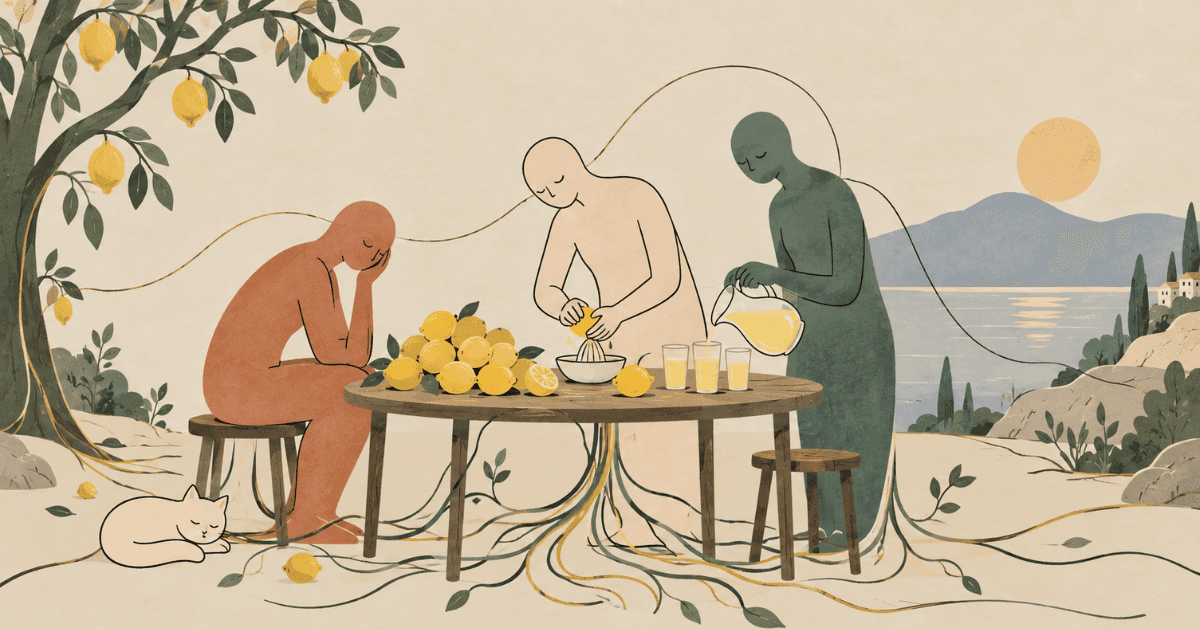
Suffering is an unavoidable part of life, but it isn't a personal failure or something we must constantly strive to overcome. Drawing on psychological research, philosophy, and Buddhist teachings, this essay explores how acceptance, compassion, and meaningful action can coexist with hardship. Happiness doesn't require the absence of suffering, and hope doesn't require certainty that things will improve. By recognizing the limits of individual control and the power of our connections with others, we can move beyond relentless self-improvement toward a more practical, compassionate, and collective understanding of well-being.
Sometimes life is genuinely difficult. Financial insecurity, strained relationships, illness, caregiving responsibilities, political uncertainty, and the ordinary accumulation of obligations can leave people exhausted. Some problems are temporary. Others persist for years. Some are beyond our individual capacity to resolve. It is tempting to respond to these difficulties with encouragement. Think positively. Practice gratitude. Focus on what you can control. Find the lesson in your suffering. If life gives you lemons, make lemonade.
There is nothing inherently wrong with these suggestions. Under the right circumstances, some may be useful. But they can also obscure something important: sometimes life is difficult because our circumstances are difficult, not because we are approaching them with the wrong attitude. Sometimes we don’t want lemonade. Quit telling me to make lemonade, y’all.
Suffering Is Part of the Human Condition
Buddhism begins with a remarkably practical observation: suffering and dissatisfaction are part of human existence. The First Noble Truth identifies dukkha, a term that encompasses not only obvious suffering but also the instability and unsatisfactory nature of experiences that cannot provide lasting security. It acknowledges something most people already know. We experience pain. We lose people and things we value. Our bodies change. Relationships evolve. Circumstances rarely unfold exactly as we expect. Even pleasant experiences are temporary.
The Buddhist response is not simply to eliminate every unpleasant experience. It involves examining how our resistance, attachments, and expectations can add to the suffering already present. Recognizing suffering does not mean approving of it. Accepting that something is happening does not mean deciding that it should continue. We can acknowledge reality while working to change it.
There is an idea in Buddhism, non-duality, that I find especially helpful here. We tend to divide our experiences into opposing categories: good or bad, acceptable or unacceptable, something to embrace or something to reject. But is that really how reality works? When we suffer, our first instinct is often to identify the cause or figure out how to make it stop. Yet Buddhist teachings on dependent origination and impermanence suggest a more complicated picture. What we want to stop is often not a fixed thing but an unfolding process, shaped by a long chain of interacting conditions. To say that one particular event caused our suffering, or that one particular change will make us happy, may be an oversimplification. And even when we are suffering, is our experience ever entirely made up of suffering? There may also be moments of connection, curiosity, affection, or simple awareness. Non-duality invites us to loosen these rigid distinctions and experience what is happening without immediately sorting everything into categories or demanding that it be different. There is value in analyzing our experiences and trying to understand them, but there is also value in simply experiencing them. And the Buddhist teaching of impermanence reminds us that even suffering is not a fixed, permanent state. Our experiences arise, change, and pass away. That doesn't mean our difficulties will disappear on command, but it does mean that what we are experiencing now is not necessarily what we will always experience.
Happiness Is Not the Absence of Difficulty
I know I am somewhat mocking the whole lemons to lemonade thing and if you’ve have ever been on the receiving end of this platitude it can be quite infuriating. But there is wisdom in it. You see the implication is that life gives you a hard time make something fun and delicious. But what is that fun and delicious thing? It is the stuff that was making you suffer. So happiness is made out of suffering. Now this strain of thought can lead to some weird conclusions about how whatever doesn’t kill us makes us strongers which is not my point. However I think it is critical to understand that happiness and well-being are not just the absence of suffering, its usually baked right in … mixed in. Whatever you get the metaphor.
Thich Nhat Hanh, the Vietnamese Zen Buddhist teacher, explored something similar through his concept of interbeing. Nothing exists entirely independently; everything arises through its relationships with other things. He applied this understanding to suffering and happiness, suggesting that they are not entirely separate experiences but deeply interconnected (Nhất Hạnh, 2006, 2014). Our experiences of joy, relief, gratitude, and connection can be shaped by our encounters with difficulty. This doesn't mean we need to suffer to appreciate happiness, or that suffering is somehow good for us. Rather, it challenges the assumption that happiness and suffering must occupy opposite sides of our experience. They can coexist, influence one another, and change together. Perhaps the point isn't always to transform suffering into happiness, but to recognize that life contains both, often at the same time.
The philosopher Daniel Haybron (2001) challenges the assumption that happiness can be reduced to pleasure. Our emotional lives involve more enduring patterns of experience than simply feeling good at a particular moment. Psychological research supports this as well. Rather than treating it as a single emotional state, researchers distinguish between life satisfaction, positive emotions, and negative emotions. These dimensions are related, but they do not always move together. A major meta-analysis of longitudinal studies found that different components of subjective well-being change differently over the lifespan (Buecker et al., 2023). Happiness is not a fixed condition, nor does it follow one universal trajectory.
We often evaluate our lives according to how we feel about them right now. But a painful period does not necessarily invalidate everything else that gives our lives value. It is possible to experience grief while maintaining meaningful relationships. It is possible to feel overwhelmed while acting with integrity. It is possible to be uncertain about the future while remaining committed to something worthwhile. None of this makes suffering pleasant or desirable. It simply suggests that suffering and living meaningfully are not mutually exclusive.
Compassion Before Self-Improvement
The lemonade advice often sounds like the grade-school prerequisite for the bootstrap argument. "Life Gives You Lemons 101" is offered in the spring, and you need to pass that before you can take "Pull Yourself Up by Your Bootstraps 300" in the fall. The theme is always the same: progression. You must adapt, you must build, you must push, you must pull. You must, you must, you must. It's always about movement. And sure, we have to keep moving. Time doesn't stop. Change is inevitable. So why are we so determined to force it? Sit with the damn lemons for a minute. Eight-week abs. Ten easy steps to a happier you. Another system, another pill, another program. Even our suffering has become something we're supposed to optimize.
The philosopher Ondřej Beran (2021) offers an interesting alternative to accounts of wisdom that focus primarily on successfully managing our lives. He suggests that wisdom may involve a compassionate understanding of life's difficulties, including the ability to appreciate human vulnerability without immediately passing judgment. This is particularly relevant to contemporary discussions of well-being, where nearly every difficulty seems to invite another strategy for self-improvement. We are encouraged to become more resilient, productive, emotionally regulated, mindful, and psychologically flexible. Many of these capacities are valuable. But there is a risk of turning well-being into another performance standard.
A person struggling under difficult circumstances may begin to believe that their inability to feel better represents a personal failure. Compassion offers a different response. Perhaps the first question should not be, "What should I be doing differently?" Perhaps it should be, "What is making this difficult, and what would actually help?" Sometimes the answer involves changing our behavior. Sometimes it involves rest, assistance, better relationships, or more adequate resources. Sometimes there is no immediate solution, and acknowledging that is wisdom also.
We Still Have Some Capacity to Act
Listen, I'm a fixer. You tell me about a problem, and my first instinct is to try to fix it, to offer advice. I'm the annoying lemonade guy. Why? Because the compelling part of that stupid adage is the question underneath it: here's what you've got, now what are you going to do about it? I've learned, however, that sometimes people aren't looking to be fixed. They don't want advice. They just want your presence. And sometimes that's exactly what they need.
But we also know people who seem to get stuck in their suffering. They poke holes in every suggestion. They don't like lemonade, they hate lemon zest, and it turns out they're allergic to lemons anyway. Nothing seems possible. Everything feels hopeless. And sometimes it seems that even acknowledging their suffering is unbearable, as though recognizing reality means endorsing it. Of course, as the resident lemonade guy, I have to be careful here. What looks like resistance from the outside may be exhaustion, fear, depression, or circumstances I don't fully understand. My desire to fix something doesn't necessarily mean that I understand what needs fixing. But I don't think the alternative is to abandon the possibility of change. Acknowledging suffering does not require abandoning agency.
Autonomy does not mean complete independence or control over our circumstances. It concerns our capacity to make meaningful choices and act in accordance with our values. Research consistently identifies autonomy as an important correlate of subjective well-being. A meta-analysis by Yu et al. (2018) found a positive relationship between autonomy and well-being across American and East Asian populations. We may not be able to eliminate uncertainty, repair every relationship, or change the larger systems shaping our lives. But there may still be actions available to us that express our values. DeYoung and Tiberius (2022) develop a theory of well-being centered on value fulfillment. From their perspective, living well involves pursuing and realizing what matters to us through ongoing processes of self-regulation. Caring for someone. Asking for assistance. Establishing a boundary. Participating in a community. Learning something. Contributing to an effort whose outcome remains uncertain.
These actions do not guarantee happiness. Their importance does not depend entirely on whether they succeed. We can act meaningfully without controlling the result. Buddhist practice offers a parallel insight. The recognition of impermanence can loosen our insistence that circumstances unfold according to our preferences. But it need not produce passivity. Suffering is real, and in a very real sense inevitable, but circumstances continue to change, including the conditions that shape our suffering. And while the wheel keeps turning, we continue to respond to what happens around us. Sometimes deliberately, sometimes out of habit, and sometimes with very little room to maneuver. We may avoid a difficult conversation, withdraw from others, ask for help, or attempt something new. Even letting those lemons rot can shape what happens next, although it isn't always a freely chosen response.
The Noble Eightfold Path includes ethical conduct, wise effort, and deliberate action. It does not promise complete control over our circumstances. Instead, it offers a way of responding thoughtfully to conditions that are constantly changing. We act where action is possible while recognizing that outcomes arise from conditions we do not fully control. Perhaps that's the useful part of the lemonade metaphor after all. We don't get to choose every ingredient, and we certainly don't have to pretend to like the lemons. But understanding what we've been given can help us recognize what, if anything, we might do next.
We Cannot Do Everything Alone
There is also a limit to how much individual resilience can accomplish. I have the lemons, but I certainly don't have any sugar, and I don't want to ask my neighbor for a cup because my neighborhood is dangerous. I guess I could go to the grocery store, but everything is so expensive, not to mention the fact that my car is in the shop. Making lemonade is becoming a rather complicated undertaking.
Research on social connection demonstrates that relationships and isolation matter for human health and well-being. An umbrella review of randomized interventions found that social and psychological approaches can help reduce disconnection, although their effectiveness varies (Hansen et al., 2024). Other research identifies education, autonomy, economic circumstances, and opportunities for participation as important correlates of subjective well-being (Azizan & Mahmud, 2018; Dong et al., 2025; Yu et al., 2018).
Our opportunities to live well depend partly on circumstances we share with others. A person working multiple jobs, struggling to afford housing, or caring for a family member with inadequate support faces constraints that meditation alone cannot resolve. Personal practices can help us respond to those circumstances. They cannot substitute for adequate social support or changes to harmful conditions.
This is where individual agency becomes collective agency. We can organize, cooperate, share resources, and work toward conditions that none of us could create independently. Such efforts may not succeed immediately. But they can expand what is possible while reducing the isolation that often accompanies hardship. Hope need not depend on believing that everything will work out. It can be grounded in the recognition that our possibilities are not limited to what we can accomplish alone.
This ties directly back to the Buddhist notion of an interconnected reality, or interbeing. A lemon is sunshine and rain, nourished by the soil. Lemon trees can self-pollinate, so I'm stretching my metaphor here, but bear with me. Bees carry pollen between flowers and return to their hives to make honey. Bears eat the honey and occasionally the fish swimming in rivers that help nourish the surrounding landscape. The water supports the soil, the soil supports the trees, and eventually we have our lemons. Cue the Lion King music. The point is that none of these things exists entirely independently. They arise through relationships and conditions that extend far beyond themselves (Nhất Hạnh, 2006, 2014).
Community organizing and collective agency can sound like something with an email list. Something you have to sign up for, attend meetings about, and possibly bring a covered dish to. But the truth is that we're already deeply embedded in networks and communities. We cannot be entirely independent. Our lives depend on other people, institutions, environments, and systems, whether we consciously participate in them or not.
What we can do is choose, within the limits of our circumstances, how we interact with these communities and how we might influence the conditions we share. We can strengthen relationships, offer support, participate in local decisions, organize around common concerns, or simply make ourselves more available to the people around us.
You can't have the lemon without the lemon tree, and you can't have the tree without the conditions that allow it to grow. The encouraging part is that these relationships aren't merely constraints on our independence. They can also be sources of support, opportunity, and meaningful participation. Research on social connection and autonomy suggests that these aspects of our lives matter for well-being (Hansen et al., 2024; Yu et al., 2018).
Hey, it looks like you’ve got some lemons. We should make some lemonade.
Hope as a Practical Orientation
Hope is a tricky thing. It often begins with a dissatisfaction with the present, or at least a recognition of the distance between what is and what could be. And sometimes that dissatisfaction is entirely warranted. But the power of hope is that it doesn't require achievement. We don't have to accomplish our goals for hope to matter. Perhaps hope is partly the experience of autonomy embedded in the present, the recognition that even when we cannot determine the outcome, we may still have some capacity to influence what happens next. Maybe hope is most useful when we stop treating it as a prediction. Optimism suggests that things will turn out well. Hope can be something more modest: the willingness to remain engaged with possibilities that have not yet been determined.
There is no guarantee that our circumstances will improve quickly. Some losses cannot be reversed. Some problems require collective changes that may take generations. We can acknowledge these realities without concluding that our actions are meaningless. The research suggests that autonomy, connection, and meaningful participation are relevant to well-being. Philosophy helps explain why pursuing our values can matter even when outcomes are uncertain. Buddhism reminds us that suffering and impermanence are ordinary features of existence rather than evidence that life has gone wrong.
Together, these perspectives offer a response to difficult times that does not require forced positivity. We can recognize suffering without exaggerating our control over it. We can treat ourselves and others with compassion without abandoning responsibility. We can make practical changes where possible and seek support where individual effort is insufficient. And we can continue participating in the world without needing assurances about how everything will turn out. Hope, understood this way, is not the conviction that things will get better. It is the recognition that our circumstances are not necessarily fixed, that our actions can still matter, and that we do not have to face life's difficulties alone. That may not be particularly inspirational. But it gives us somewhere to begin.
So life gave Us lemons...
References
Azizan, N. H., & Mahmud, Z. (2018). Determinants of subjective well-being: A systematic review. Environment-Behaviour Proceedings Journal, 3(7). https://doi.org/10.21834/e-bpj.v3i7.1228
Beran, O. (2021). The wisdom of insight. Philosophy East & West, 71(3), 562–581.
Buecker, S., Luhmann, M., Haehner, P., Bühler, J. L., Dapp, L. C., Luciano, E. C., & Orth, U. (2023). The development of subjective well-being across the life span: A meta-analytic review of longitudinal studies. Psychological Bulletin, 149(7–8), 418–446. https://doi.org/10.1037/bul0000401
DeYoung, C. G., & Tiberius, V. (2022). Value fulfillment from a cybernetic perspective: A new psychological theory of well-being. Personality and Social Psychology Review. https://doi.org/10.1177/10888683221083777
Dong, X., Xing, Z., Song, H., & Hu, D. (2025). The impact of education on subjective well-being: A meta-analysis based on 59 empirical studies. Frontiers in Psychology, 16, 1651896. https://doi.org/10.3389/fpsyg.2025.1651896
Hansen, T., Nes, R. B., Hynek, K., Nilsen, T. S., Reneflot, A., Stene-Larsen, K., Tornes, R. A., & Bidonde, J. (2024). Tackling social disconnection: An umbrella review of RCT-based interventions targeting social isolation and loneliness. BMC Public Health, 24, 1917. https://doi.org/10.1186/s12889-024-19396-8
Haybron, D. M. (2001). Happiness and pleasure. Philosophy and Phenomenological Research, 62(3).
Yu, S., Levesque-Bristol, C., & Maeda, Y. (2018). General need for autonomy and subjective well-being: A meta-analysis of studies in the US and East Asia. Journal of Happiness Studies. https://doi.org/10.1007/s10902-017-9898-2